

You’ve just closed your best quarter ever. The spreadsheets show record-breaking sales, your team is expanding, and the “profit” line on your P&L looks healthier than it has in years. Yet, when you check your business bank account at 2:00 AM, the number staring back at you barely covers next week’s payroll and VAT bill. Where did the money go?
This paradox being profitable on paper but cash-poor in reality is the single most common cause of business failure. It’s a quiet, stressful crisis that keeps founders awake at night. The hard truth is that profit is an accounting opinion, while cash is a physical reality. Most companies don’t go under because they lack a market or a product; they go under because they run out of oxygen. To solve this, many smart directors are moving away from traditional, reactive bookkeeping and instead outsourcing accounting services to gain a tactical grip on their liquid assets.
Outsourcing isn’t just about handing off a chore to someone else. It is about replacing a fragmented, manual process with a high-performance financial engine designed to move cash through your business faster.
Why Cash Flow Problems Persist?(Even in Growing Businesses)
Growth is expensive. In fact, growth is often the very thing that kills cash flow. When you scale, you pay for your inputs (labor, stock, marketing) today, but you might not see the return for thirty, sixty, or ninety days. Without a systems-level view, this gap becomes a canyon.
The problems rarely stem from a lack of revenue. Instead, they thrive in the “blind spots” of your financial operations. Think about your current receivables tracking. Are you waiting until the end of the month to see who hasn’t paid? By then, the damage is done. Manual bookkeeping errors, while seemingly small, can snowball into incorrect tax filings or missed payment deadlines that incur hefty penalties.
Most critically, many businesses operate without any form of structured cash flow forecasting. They are reactive, not proactive. They wait for a crisis to check their liquidity rather than anticipating a dip three months in advance. Expense leakage of those small, untracked subscriptions and misclassified spends further thins the margins. These aren’t revenue problems; they are visibility problems.
What Outsourced Accounting Actually Means?
If you think of accounting as just “filing the taxes and doing the books,” you are only seeing half the picture. In a modern context, outsourcing accounting services provides an end-to-end financial department that functions as your strategic partner.
It encompasses the day-to-day (bookkeeping and payroll), the regulatory (tax compliance and VAT), and the high-level (management reporting and advisory). It isn’t a cost-cutting exercise where you find the cheapest person to enter data. It is an operational upgrade. You are buying a team of specialists and a tech stack that would be far too expensive to build in-house, all aimed at one goal: making your business more efficient and your cash more predictable.
7 Ways Outsourced Accounting Improves Cash Flow
How does this actually translate to more money in the bank? It’s not magic; it’s a series of mechanical improvements to your financial cycle.
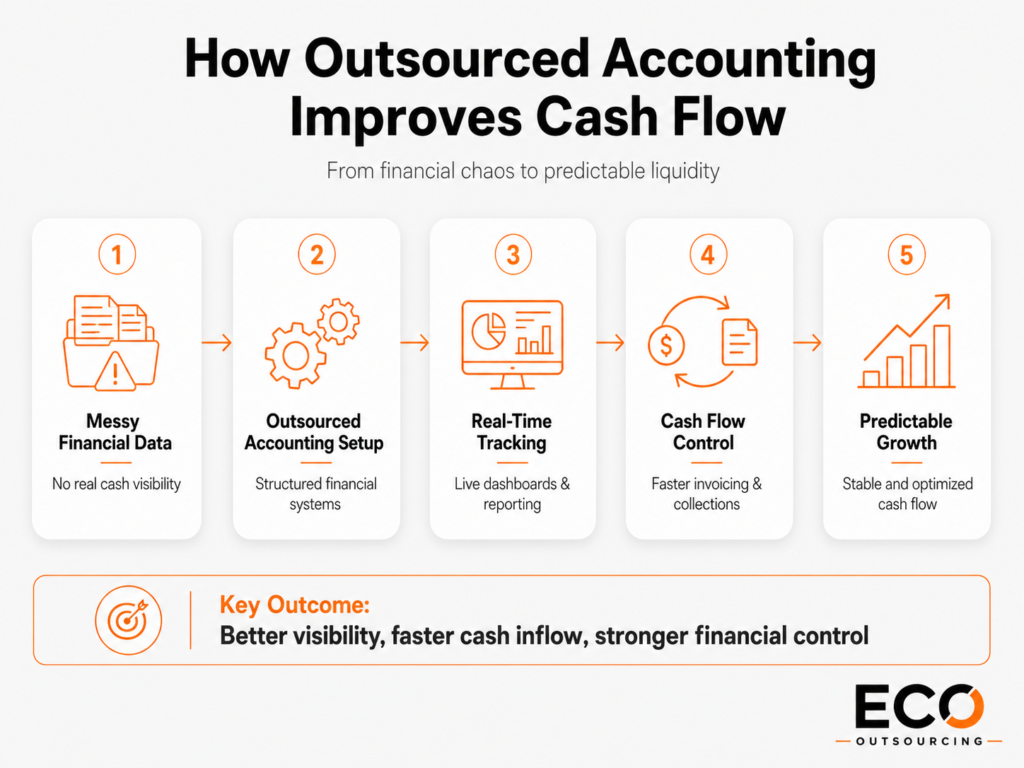
Real-Time Financial Visibility
Most business owners make decisions based on data that is weeks or even months old. Operating this way is like driving a car while looking only at the rearview mirror. You might see where you were, but you have no idea what’s ahead. Professional outsourced teams implement live dashboards linked directly to your bank feeds and sales platforms. This means you can see your exact cash position at 9:00 AM on a Tuesday, allowing you to make faster, more confident decisions about hiring, purchasing, or investment.
Faster Invoicing and Payment Cycles
The longer the time between delivering a service and sending an invoice, the higher the risk of non-payment. Friction in your billing process is a direct tax on your cash flow. By automating invoicing and setting up digital payment gateways, an outsourced team shortens your “cash conversion cycle.” If you can reduce your average payment time from 45 days to 15 days, you have effectively injected a massive amount of working capital back into your business without selling a single extra unit.
Stronger Accounts Receivable Management
Chasing late payments is awkward, time-consuming, and often neglected by busy founders. When it is neglected, your customers treat you like an interest-free bank. An outsourced accounting partner implements structured credit control. They send professional reminders, flag high-risk debtors early, and ensure that “payment on receipt” actually means what it says. This consistency changes customer behavior, leading to a much more predictable cash inflow.
Expense Control and Leakage Reduction
In a busy company, it is easy for “subscription fatigue” to set in. A £50 software tool here and a £200 service there might not seem like much, but they add up to a significant annual drain. Dedicated accountants monitor and categorize every outgoing. They spot the “leakage” unnecessary costs or duplicate payments and flag them immediately. This isn’t about being “stingy”; it’s about ensuring every pound spent is earning its keep.
Accurate Cash Flow Forecasting
What happens if your largest client leaves? What if you decide to buy a new warehouse in October? Most businesses guess the answers to these questions. An outsourced team uses rolling forecasts and scenario planning to model these “what-ifs.” This moves you away from “finger-in-the-wind” management to a state of predictable liquidity. You’ll know exactly how much cash you’ll have in six months, allowing you to sleep better and plan more aggressively.
Reduced Financial Errors
A single misplaced decimal point or a misunderstood VAT rule can lead to thousands of pounds in fines or overpaid taxes. Professional oversight ensures your records are not just “done,” but accurate. High-quality data is the only foundation for reliable cash planning. If the data is wrong, the plan is useless.
Strategic Financial Insight
Beyond the spreadsheets, a seasoned accountant provides advisory. They can identify working capital gaps you didn’t know existed. Perhaps you are holding too much stock, or maybe your supplier terms are too tight. These insights aren’t just about tracking money; they are about optimizing how money moves through your organization.
The Before and After of Outsourcing
| Metric | Before Outsourcing | After Outsourcing |
| Data Recency | 30–60 days old | Real-time (Daily/Weekly) |
| Invoicing | Manual and inconsistent | Automated and immediate |
| Decision Making | Reactive (based on gut feel) | Proactive (based on trends) |
| Cash Visibility | “Bank balance” management | Detailed 13-week forecasts |
| Error Rate | High (due to time pressure) | Low (due to expert oversight) |
Managing the Risks
It would be dishonest to suggest that outsourcing is without its challenges. Handing over your financial “engine room” requires trust. Many directors fear losing control or worry about data security.
To avoid these pitfalls, look for a partner who uses cloud-based tools like Xero or QuickBooks. This ensures you maintain 24/7 access to your data you are granting them access, not giving up ownership. Communication is also vital. A good provider won’t just send you a report; they will schedule a monthly call to walk you through what the numbers actually mean.
Who Benefits the Most?
- Startups: For a company in its early stages, “runway” is the only metric that matters. Every pound saved through better expense tracking extends that runway, giving the product more time to find its market.
- SMEs: Small-to-medium enterprises often suffer from “lumpy” cash flow busy months followed by quiet ones. Outsourcing provides the consistency needed to survive those dips.
- Scaling Businesses: When you are growing fast, you can no longer manage finances on a spreadsheet. You need robust systems that can handle increased complexity without breaking.
Is It Worth the Investment?
The hesitation most directors feel comes down to the monthly fee. They compare the cost of outsourcing accounting services to the cost of doing it themselves for “free.”
But consider the true cost of your time. If you spend five hours a week on bookkeeping, that is 20 hours a month. If your time is worth £100 an hour, you are “paying” £2,000 a month to do a job you probably dislike and might be doing incorrectly. When you factor in the reduced errors, the reclaimed time, and the improved cash position, the ROI isn’t just positive.it’s transformative.
Choosing the Right Partner
Not all providers are created equal. When evaluating a potential partner, look for these markers of quality:
- UK Regulation Expertise: Tax laws in the UK are idiosyncratic. Ensure they have a deep understanding of HMRC requirements.
- Modern Tech Stack: If they ask you to send paper receipts in the post, run. Look for teams that embrace AI and cloud integration.
- Scalability: Can they grow with you? You don’t want to outgrow your accountant in eighteen months.
- Reporting Frequency: Will they talk to you every week, or just once a year?
Common Misconceptions
Outsourcing is only for large companies.False. In many ways, small companies need it more because they have smaller margins for error.
I will lose control of my finances.The opposite is true. Most founders feel more in control when they can finally see clear, accurate data instead of a confusing mess of bank statements.
It’s just fancy bookkeeping. Bookkeeping is a recording of history. Strategic outsourced accounting is a map for the future.
FAQs(Frequently Asked Questions)
What is outsourced accounting and how does it relate to cash flow management?
Outsourced accounting means hiring an external firm to handle your financial records, reporting, and analysis instead of managing them in-house. These professionals monitor your cash inflows and outflows in real time, giving you an accurate picture of your financial position. This proactive oversight helps identify cash flow gaps before they become serious problems. As a result, your business can make smarter, faster financial decisions.
How can outsourced accounting help my business avoid cash flow shortages?
Outsourced accountants track your receivables and payables closely, ensuring invoices are sent on time and payments are chased promptly. They also forecast future cash needs based on your income patterns and upcoming expenses. This forward-looking approach means you are never caught off guard by unexpected shortfalls. Your business stays liquid and financially stable throughout the year.
Can outsourced accounting reduce unnecessary business expenses?
Yes,outsourced accountants regularly review your spending to identify costs that can be reduced or eliminated entirely. They analyse your financial data to spot patterns of wasteful expenditure that often go unnoticed internally. By trimming unnecessary overheads, more cash remains available for operations and growth. This alone can significantly improve your overall cash flow position.
How does outsourced accounting improve invoice and payment management?
Professional outsourced accountants implement structured invoicing systems that ensure bills go out promptly and follow-ups happen automatically. They also negotiate better payment terms with suppliers to ease pressure on your outgoings. This dual approach of speeding up income and slowing down expenses creates a healthier cash flow cycle. Your business spends less time chasing payments and more time focusing on growth.
Is outsourced accounting cost-effective for small businesses managing cash flow?
Absolutely,hiring a full-time in-house accountant is expensive when you factor in salary, benefits, and training costs. Outsourced accounting gives you access to a full team of financial experts at a fraction of that cost. The money saved can be redirected back into the business to strengthen cash reserves. For small businesses especially, this makes outsourced accounting one of the smartest financial decisions you can make.
Moving Toward a Strategic Finance Function
Cash flow problems are rarely about the money you’re making; they are about the systems you’ve built to manage it. When you treat your finance function as a strategic tool, one that provides visibility, control, and foresight, you give your business the freedom to grow without the constant fear of a cash crunch.
That is where Eco Outsourcing comes in. From bookkeeping and payroll to cash flow forecasting and management reporting, Eco Outsourcing delivers accurate, real-time financial insights tailored to your business needs. Their experienced team eliminates inefficiencies and plugs cash flow gaps so you can stop reacting and start growing.
You didn’t start your business to be a bookkeeper, you started it to lead. Let Eco Outsourcing handle the numbers while you handle the vision.