
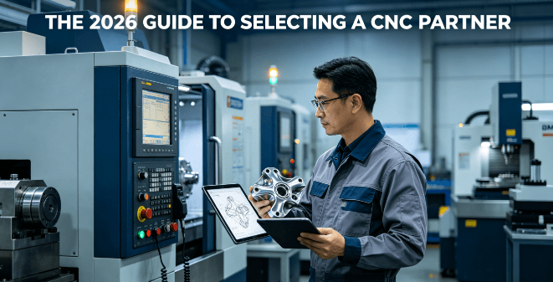
When sourcing CNC machining service providers globally, there are many obstacles to overcome. With a wide range of service providers to choose from and prices fluctuating greatly from one service provider to another, along with inconsistent service quality and unconfirmed delivery times, it is difficult to make an informed decision. The main problem is that traditional approaches to selecting service providers depend heavily on individual testimonies or quotations without applying any systematic assessment process.
This article consolidates industry practices to present a systematic evaluation framework. It outlines the 5 critical dimensions essential for assessing a top-tier CNC machining service provider in 2026. This serves not only as a risk mitigation guide but as a robust methodology for efficient supplier screening. Let’s delve into this framework and uncover what truly sets exemplary partners apart.
Top 5 Key Metrics for Evaluating a CNC Machining Supplier (Beyond Price & Certificates)
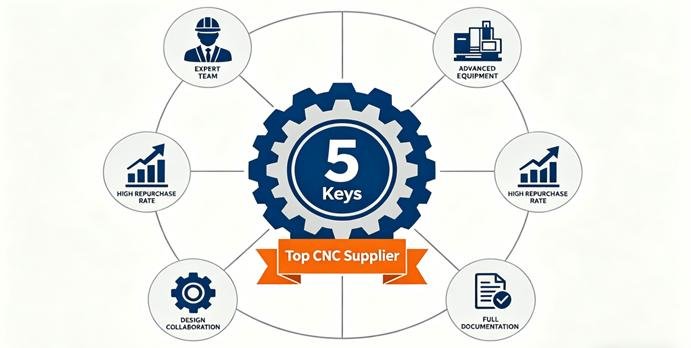
A frequent mistake made is considering ISO 9001 certification and the quotation alone. According to the experts in the industry, capability must be proven through measurable statistics. The first step involves having a team of engineers who have more than ten years of experience. Secondly, examine the machinery used, such as 5-axis machining and the capabilities of the CMM inspection.Third, a client repurchase rate is always above 55% serves as compelling evidence of satisfaction. Fourth, assess whether collaborative design support is institutionalized and responsive during the quotation phase. Finally, the ability to provide full documentation like FAIR reports reflects essential full traceability capability for demanding sectors.
Top 4 Core Considerations for Stainless Steel Selection and Machining (304 vs. 316)
The selection of either 304 or 316 stainless steel in Stainless Steel CNC Machining is key to cost and performance considerations. These are the four key elements for making a decision.
Corrosion Resistance: The Environment Makes the Call
When the environment contains chlorides, such as for marine use or medical CNC machining, the greater level of molybdenum in 316 stainless steel gives you an absolute edge. Not considering this might result in part failure before time.
Meeting Non-Magnetic Requirement
Many precision tools need parts that are assured to be non-magnetic. Remember that cold working can lead to the parts becoming slightly magnetic even for austenitic steel grades like 304 and 316. It is important to have the supplier follow certain steps to ensure that this happens. A deeper discussion on this specific property can be found in this resource: Stainless Steel CNC Machining.
- Strength and Work Hardening
While 316 generally offers slightly higher strength, both grades exhibit significant work-hardening characteristics. This poses challenges for tool selection and cutting parameters, directly influencing tool life and overall machining cost.
- Total Cost Analysis (TCA)
Material selection must involve a comprehensive TCA. Although 316 material is more expensive, its extended service life in harsh environments may offer better long-term value, justifying the initial investment.
Top 3 Decision Points for Machining Process Selection of Complex Parts (Aerospace/Medical)
For high-value CNC machining aerospace parts and medical components, the choice of machining process is a critical success factor, hinging on three key decisions. First, assess geometric complexity versus setup count; 5-axis precision CNC machining minimizes setups, boosting accuracy to levels like ±0.008mm and cutting time by 30% for parts like impellers. Second, surface integrity is paramount for fatigue life and biocompatibility, requiring expertise to control subsurface stress. Finally, the economic batch size breakeven point must be calculated, as 5-axis machining can offer lower total cost for medium batches (500-1000 pieces) by reducing fixturing and secondary operations.
Top 3 Hidden Cost Traps and the Total Cost of Ownership (TCO) Model
Budget overruns in CNC machining services China projects often stem from hidden costs. The following are the three most common traps.
The “Incomplete” Base Quote Trap
The seemingly inexpensive quotation of CNC machining for stainless steel may not have included special packing charges, export documents, inspection reports from third parties, or import taxes. They normally add 15-20% to the overall expenses.
- Programming and Setup Costs
In low-volume orders, high programming and fixture costs are amortized over a small number of parts, leading to a unit price far exceeding expectations.
- Material Minimum Order Quantity (MOQ)
The MOQ for special material grades can result in significant raw material waste, an indirect cost often overlooked in the initial quote.
H3: The Communication and Engineering Change Order (ECO) Trap
DFM communication inefficiency and design changes take up considerable engineering effort, lead to project delays, and are costly. Proactivity is achieved through the development of TCO model. In purchasing products, buyers must ask for detailed quotes from their suppliers that cover all costs incurred from material to delivery.
Top 2 Traits of a Top-Tier Supplier, Demonstrated by a Success Case Study
A case-in-point would be a company that requires precise, non-magnetic surgical instruments made out of 316L material. In the successful cooperation, it was possible to define two characteristics possessed by elite suppliers. First, the level of technical expertise and DFM was crucial by modifying the design of the internal cavity in the device, it became possible to use standard machining tools, and thereby reduce machining time by 30 percent while reducing wear-and-tear on the tools by 25 percent. Secondly, having a systematic approach to quality assurance and integration through using CMM and 3D-scanners is crucial for ensuring reliability. Complying with such standards as ISO 13485 and IATF 16949 rather than ISO 9001 alone is a better proof of capacity. A partner like JS Precision, certified to ISO 13485 and IATF 16949, embodies this trait, ensuring extreme reliability from prototype to production.
Conclusion
In 2026, selecting an excellent CNC machining service provider extends far beyond price comparison. It constitutes a comprehensive evaluation of engineering depth, process control systems, supply chain efficiency, and cost transparency. The five-dimensional framework outlined in this article provides a clear roadmap for this critical assessment.
For professionals facing precision component manufacturing challenges and seeking a partner that creates real value through deep engineering collaboration and systematized manufacturing, initiating a professional technical assessment is recommended. Before launching your next project, a thorough review of a comprehensive guide on selecting global partners can be invaluable. This resource on CNC machined components manufacturers can help build a more complete decision-making framework.
Author Biography
This article is written by an industry consultant who has more than ten years of experience in precision manufacturing projects in a transnational environment, with the intention of contributing practical lessons to engineers and procurement managers. The viewpoints and data analysis presented in this article have been generated by JS Precision, an expert in precision manufacturing services.
FAQs
Q: Among the evaluation metrics you listed, which is the most overlooked yet most important?
A: The average experience level of engineers is most frequently overlooked. While automated equipment can be purchased, the process know-how of engineers with over ten years of experience cannot be replicated. They are the core asset for solving complex tolerance issues and optimizing DFM to reduce costs.
Q: What needs to be considered when manufacturing non-magnetic medical components?
A: Besides choosing the low-carbon austenitic alloy, including 316L, it is necessary to control the machining process and maybe apply heat treatment in order to guarantee non-magnetism.
Q: Is there an easy way to see if the supplier has total cost of ownership data at hand?
A: Just request a quotation from your suppliers with all potential cost items mentioned, from raw material, machining, heat treatment, finishing, full quality documentation, packaging, exporting documents, and even expected freight cost. The ones who are unable or unwilling to do so are not good business partners..
Q: What are the essential supplier features for R&D compared to production?
A: In case of small batches required for research and development purposes, focus on rapid feedback regarding DFM (design for manufacturing) and capability of quick iterations. For the production phase, it is more important to consider supplier’s supply chain stability and process control capability in terms of SPC application..
Q: Many of the suppliers are ISO 9001 certified. Is that enough?
A: ISO 9001 is the baseline quality management systems standard. For sectors such as the auto, aerospace, or medical, for example, IATF 16949, AS9100D, and ISO 13485 standards respectively are more advanced and can be seen as certificates of capability.
 Professor