
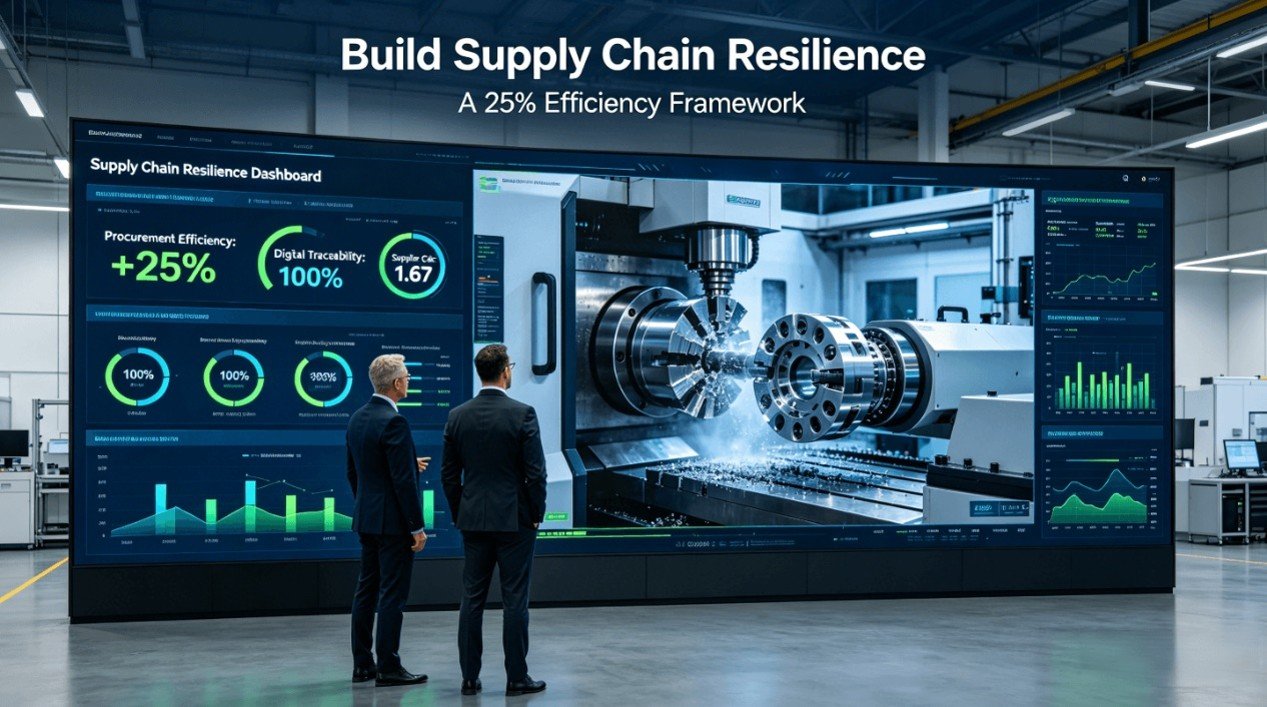
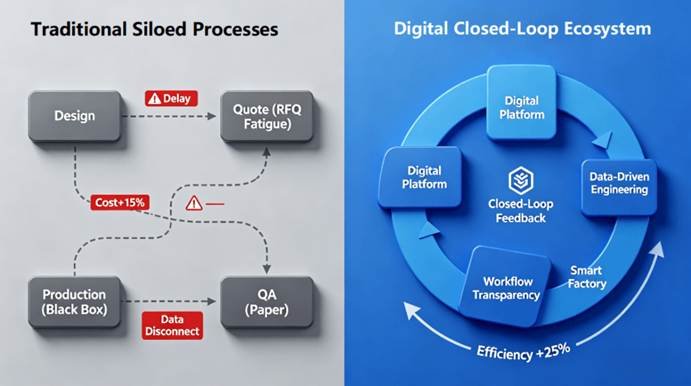
Global manufacturers find themselves under extreme pressures. Supply chain disruption results in delays of several weeks for crucial components. The hidden cost associated with working with several suppliers through traditional methods could eat up to 15 percent of a project’s budget. There is a “data disconnect” between prototyping and manufacturing processes that leads to costly changes during the late stages of design and wastage.
The main issue is the disjointed procurement process. The traditional approach involves separate actions in design, quotations, manufacture, and quality assurance. The process lacks a digital thread across all stages, leading to poor communication and inefficiency. This paper presents a procurement model in four dimensions, which integrates a digital platform, data-driven engineering, workflow transparency, and smart factory insights in a closed-loop cycle, resulting in 25 percent increased procurement effectiveness.
How does strategic sourcing evolve from vendor management to digital partnership ecosystems?
Strategic sourcing is shifting from vendor management to establishing a fully-fledged digital partnership ecosystem. It means that we will use platforms that enable us to work with suppliers who are data-driven and have rich analytics in their portfolio and not only provide CNC machining but also can help understand the company’s capacity needs and supply chain requirements. The ability to implement a full cycle of the online custom CNC milling services is a sign of partnership maturity.
1. RFQ Fatigue & the Shift towards Digital Platforms for Sourcing
RFQs to multiple suppliers have proven to be an ineffective strategy. Today, strategic sourcing encompasses digital platforms which serve as a single control center. Simply uploading your 3D design activates the process automatically and includes quick quotes, DFM analysis, and order management. This way, you bypass weeks of negotiation time while receiving clear insights into price and timing at the same time.
2. Assessing Digital Partnerships through Data Integration and Transparency
Selecting a digital partner demands evaluation of the intelligence and openness of its platform. Going beyond mere machine lists, assess their transparency in production scheduling, live data on available machines, and past performance indicators. The objective is to locate a partner who has designed digital platforms that can work collaboratively, allowing for the sharing of files and revisions, and facilitating communication, thus bringing clarity to an otherwise secretive process.
3. Laying Groundwork for Long-Term Engineering Cooperation
This digital network encourages cooperation. Every project creates shared engineering knowledge, which includes best practices for designing certain parts using particular materials, as well as information on how to save costs. The resulting partnership is no longer simply one of buyers and sellers but rather a collaboration between engineers working towards mutual success in the long term.
What Makes for Real Manufacturing Intelligence More Than Just a List of Machines?
Intelligence goes beyond a simple list of equipment, it depends on proprietary process know-how and information. To produce manufacturing intelligence, one needs special materials databases, machine learning-based production forecasts, and flexible tooling modules. Getting certified by the respective industry is very important in proving one’s systematic approach; especially, the ISO 9001 standard is recognized as the main quality management system that supports successful manufacturing.
- The Knowledge of Processes and Materials: Listing of five-axis machines makes little sense when one lacks the knowledge of processes related to their operation. Real intelligence comes from in-depth know-how and the database of processes, such as detailed information about milling aluminum without galling. Such knowledge embedded into software enables perfect tool paths and feeds that affect quality, surface finish, and durability of cutting tools for machining complicated parts quickly.
- Predictive Analytics for Time and Cost Based on Data: Using AI models, cutting-edge companies can predict how long the parts will take to produce, where the bottlenecks might occur, and the outcome of the results through an analysis of the geometry and materials of the pieces. This turns cost estimation into accurate predictions, helping procurement specialists plan budgeting and time much better from the very first CNC milling quotation online.
- Why Certifications Act as a Proxy for Systemized Quality Management: The standards IATF 16949 (automotive) and AS9100D (aerospace), among others, require a systematic quality management system in order to become certified. In other words, a certified company must have procedures for all possible actions, from corrective measures to calibrations. This system is the basic framework for the generation of quality products.
Is Transparency and Control Possible by Engineering It into the Manufacturing Process?
Thanks to the new generation of partnership, transparency is being made a fundamental part of the manufacturing process by introducing the IoT system. Besides the digitalization of inspection reports, also having the SPC data available in real-time is a factor that helps anticipate interventions. By doing so, the manufacturing process is made not only efficient but also leads to customer empowerment through being proactive rather than reactive in the process. McKinsey’s Industry 4. 0 report also points out this trend, stating that thorough data integration results in very substantial efficiency gains.
1. From Status Updates to Live Process Visualization
Control is only possible through visibility. Intelligent manufacturing systems are an effective means to gain live visibility into manufacturing processes. The customer can get real-time views into the manufacturing process via dashboard displays, while Internet of Things (IoT) technology will allow the tracking of machines. This increases trust and allows for early communications if any deviation occurs.
2. Digital Quality Gates and Data-Driven Acceptance
The process of quality control is no longer based on paperwork but on live streams of data. FAI reports are created and shared via digital methods. In case of vital dimensions, SPC charts become available in real time for the customer. Therefore, the quality is assured while producing, and not retrospectively. This way, the process of approving engineering becomes much faster, and it provides a definitive digital proof that proves valuable in any regulated industry.
3. Predictive Interventions and Constant Feedback Loops
Engineered visibility helps to create a cycle of feedback. If the machine tells you that a cutting tool will wear out quickly, then you can react accordingly before it happens. Moreover, data from production goes to your design and quotation engines, making it smarter for future projects. This ability to evolve is what differentiates between a good vendor and a strategic one.
What is the Key to Achieving Cost Savings through Digitalization for Small Quantities and Prototypes?
Digital integration offers cost savings in the context of small quantities. Advanced DFM finds expensive design features early on in the process. Smart scheduling combines different small quantities of CNC milling orders in order to amortize setup costs. This method allows for an exact cost driver analysis during the quotation process, taking procurement to a higher level where price is no longer the sole criterion but value engineering.
1. Eliminating Costs from the Design Process in the Digital Era
The most significant cost savings can be achieved in the design phase. The advanced digital solution conducts real-time DFM analysis and highlights costly elements such as deep pockets with small radii. Identifying these issues when milling prototypes saves costs in the future as redesigns and waste can be avoided entirely.
2. The Strength of Aggregated Micro-Manufacturing
In a conventional workshop, a ten-piece order is treated as a single occurrence, absorbing all setup expenses. On the other hand, a modern manufacturing plant with wide-ranging demands will employ intelligent planning to aggregate various small orders of customers with similar requirements. The result will be a diffusion of fixed costs, enabling micro-manufacturing at significantly lower unit costs than CNC milling.
3. Clear Cost Factors Instead of Total Price Only
The quote generated by an intelligent software system must serve a pedagogical purpose. It must detail the cost factors such as materials, labor hours, setup costs, and finishing processes. With such clarity, teams can comprehend the consequences of their design decisions on the total cost of production. For instance, they may realize how a change in materials or an additional finish affects the price.
Which Metrics Determine the Success of Digital Manufacturing Partnerships?
The success of a digital partnership necessitates evolving metrics. Moving away from “on-time delivery” and concentrating on “First-Pass Yield,” “Quote-to-Order cycle time,” and “depth of digital traceability.” A reliable quality management system is the foundation through which a successful CNC milling service partner delivers their results. Hence, while reviewing any CNC milling services, one should consider their ability to translate system certifications into meaningful and actionable performance metrics.
- Leading Indicators: Early Signs of Health: Digital partnerships support leading indicators. Quote-to-Order cycle time indicates process efficiency. Cycle time of iterations from design feedback DFM (Design For Manufacture) to the new model reveals collaboration effectiveness. Schedule adherence rate (are we working according to plan?) can give insight into upcoming on-time deliveries.
- Quality and Efficiency: The Fundamental Outcome Criteria: Ultimately, quality and efficiency are represented by the criteria used. The First Pass Yield (FPY) is the proportion of parts that pass all checks upon initial attempts. High FPY indicates an effective DFM, programming skills, and proper machining ability. Higher FPY also implies lower costs and shorter lead times.
- Traceability and Continuous Improvement: In a digitized environment, there should be a traceable link among all processes and parts involved. The measure of success is determined by how deep this digital link can go: Can we trace a serial number back to the source material batch number, the program used for processing, and the entire inspection report? In addition, are there structured lessons learned meetings held in conjunction with the partner? This would guarantee that our collaboration improves consistently.
Conclusion
In such an unstable world, the competitiveness of manufacturing procurement depends not on piece-part costs but on total stream efficiency, which is based on digital interconnectivity, data transparency, and engineering. A closed-loop, digitally-woven manufacturing procurement ecosystem requires an intentional strategy to be created for a company to be agile, resilient, and have a competitive advantage. The process should begin with changing the way you think about your manufacturing procurement partners.
FAQs
Q: Can I use online quoting for precise milling with tolerances?
A: The latest online quoting system for precise milling considers numerous parameters like materials, machines used, and tools. The accuracy is very high in these calculations. The most important thing here is that you will have immediate access to professional consultation by engineers, where your project will be thoroughly analyzed.
Q: How can digital fabrication protect my intellectual property?
A: Firstly, only a reputable company uses enterprise-level security measures in terms of file transfers, secure cloud hosting, restricted access, and automatic purging of the files after production. However, the crucial part of security is a non-disclosure agreement signed by all parties to the contract.
Q: But we need prototypes first, then production as well. Will an online service for prototyping bind us?
A: Not in the least; on the contrary, it’s an asset. When a capable online service does CNC milling of prototypes, a “digital twin” of manufacturing operations is generated — the optimized cutting and quality plans. This knowledge asset makes further scale-up cheaper and safer. You still have the flexibility to move to another supplier, but transferring a digitally proven package to a new one will be costly, and thus your current supplier becomes more efficient for manufacturing.
Q: But how does it differ from simply having a website of any machine shop?
A: It differs in its level of integration. Having a website means that there’s a line of communication. An actual digital manufacturing platform has a fully integrated workflow — it offers automated pricing, digital design for manufacturability analysis, tracking orders, and digital inspection results delivery.
Q: Is there support for the use of specialized materials such as titanium or PEEK for manufacturing medical devices?
A: Yes. Top manufacturers manage certified materials, and the system is configured to work with exotic materials such as titanium (handling temperature), or PEEK (biocompatibility finishing). Materials certification is easily traceable through the platform. Certifications from the provider (e.g., ISO 13485) are as important as the technology provided for regulated industries.
Author Bio
The insights of this article derive from many years of professional experience, including more than 15 years working in precision manufacturing and digital supply chain integration. Through the expertise that the author and his colleagues at LS Manufacturing possess, they help various organizations create manufacturing environments that are highly resilient and have the ability to perform at a very high level. Should you choose to use the “Digital Manufacturing Partner Assessment Checklist” to assess your organization for a partnership in digital manufacturing, the resources below can be utilized.
 Professor